

Paul Rendell looks at Virtuous Lady Mine (SX 47340 69850) alongside the River Tavy in the parish of Buckland Monachorum on the Maristow Estate.
Today known as Tavy Cottage, this building (above) was once a mine captain’s house and known as Virtuous Lady House. It is not known when it was built, but the 1851 census indicates that a house and cottage were there. Stables were built a few years later in the courtyard. It may have been built in 1848 after John William had died. In 1851 Virtuous Lady House was occupied by Alexander Martin, aged 39, who was a copper miner born in Cornwall. Living in Virtuous Lady Cottage was Henry Fox, aged 31, a copper miner from Buckland Monachorum.
The 1861 census shows that Grace Goss, a mine agent’s widow aged 50, lived in the house, while in the cottage lived Elizabeth Small, aged 33, a miner’s wife who was born in Bridestowe near Okehampton. Her husband is not mentioned in the census. The mine closed down sometime between 1872 and 1875.
Between 1881 and 1901 no miners lived in Virtuous Lady House, with the census saying the occupier was a water bailiff. Captain RG Roe died at Tavy Cottage, as it was known by then, in 1926. By 1948 Mrs Eva Mitchell was the owner of Tavy Cottage and she let it to a H Darlington.
Around this time Peggy Oxenford and her family lived in Tavy Cottage. Sometime later Peggy moved into the foreman’s cottage while her mum lived in the main house. When her mother died Peggy moved back into Tavy Cottage and the foreman’s cottage was used as storage. Peggy lived there until just before she died in 1995. Peggy was a Dartmoor character and I met her on a number of occasions in the late 1980s and early 1990s.
She often told me off for not looking after her dog – she used to throw the lead with the dog on the end of it at me when she wanted to show me something. Once she took me underground and found out I had been inside the mine before without permission. She often took groups underground, in fact she loved doing it all the way from the 1960s until the late 1980s. We went down through a hole in the hillside and climbed onto a stepladder made of rope and went down into a dark cavern. When our eyes had adjusted, Peggy was off like a shot and I had to try to keep up with her. She was a well-known mineralogist and a very good rock climber. It was muddy and slippery on the rocks so Peggy often had to wait for me as I fell over and struggled to get up. We came out of the tunnel into an amazing cavern where the miners had been working. She showed me some wonderful crystals. All too soon she had to lead me back out again. Peggy told me never to go into the mine by myself again – and I never did.
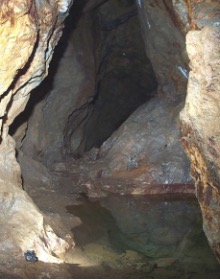
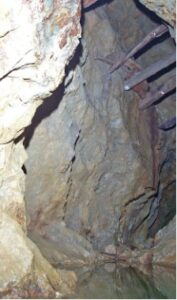
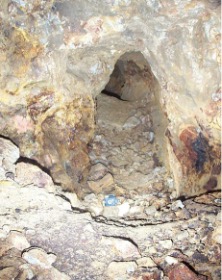
She told me there was a tunnel under the River Tavy from Virtuous Lady Mine to Little Duke Mine but she had not used it for many years as it had collapsed under the river. People kept quiet about this tunnel as Little Duke Mine was owned by the Duke of Bedford, a different owner than Virtuous Lady, and some miners would use it to nip across to Little Duke to steal tin from that mine to sell on privately. Little Duke was also known as North Tavy Mine or Raven Rock Mine.
As already mentioned, Virtuous Lady Mine closed down sometime between 1872 and 1875. It reopened in 1883 for a few months before closing again, then was worked sporadically until 1902. At the end of the 19th century the mine became a popular tourist attraction with underground tours to see the many crystallised minerals down there. Some crystals had been removed and sold but many people wanted to see them in situ.
There used to be a bridge across the River Tavy below Double Waters which allowed pack horses to cross the river and travel up to Orestocks where the ore was dumped. It was then taken down to Morwellham to be shipped out via the River Tamar. This bridge was washed away during the Great Blizzard of 1891.
Historians have written that the mine was begun in 1558 and is named after Queen Elizabeth I, but that seems unlikely; records show Virtuous Lady Mine was open in 1724 so it was possibly named after Queen Anne who reigned between 1702 and 1714.
Among the ruins of Virtuous Lady Mine today and hidden in trees, you can see the remains of a forge, the saw pit, engine house, leats and waterwheel pit. It was during the installation of the waterwheel that the eldest son of a miner’s widow was killed. His tombstone can be found in the churchyard at Calstock. It reads, ‘Sacred to the memory of Isaac Sleep, who was killed in the Virtuous Lady Mine by the crank of the waterwheel 18th August 1831, aged 14 years.’ The boy was the breadwinner.
PLEASE NOTE: Visiting old mine sites is very dangerous and should not be attempted due to numerous hazards like open shafts, wheel pits etc. Underground exploration should not be attempted either due to extreme dangers unless with a bona-fide mining or caving club.
References: www.virtuousladymine.co.uk/index.html Rendell, Paul; Exploring the Lower Walkham Valley; Forest Publishing (1996)